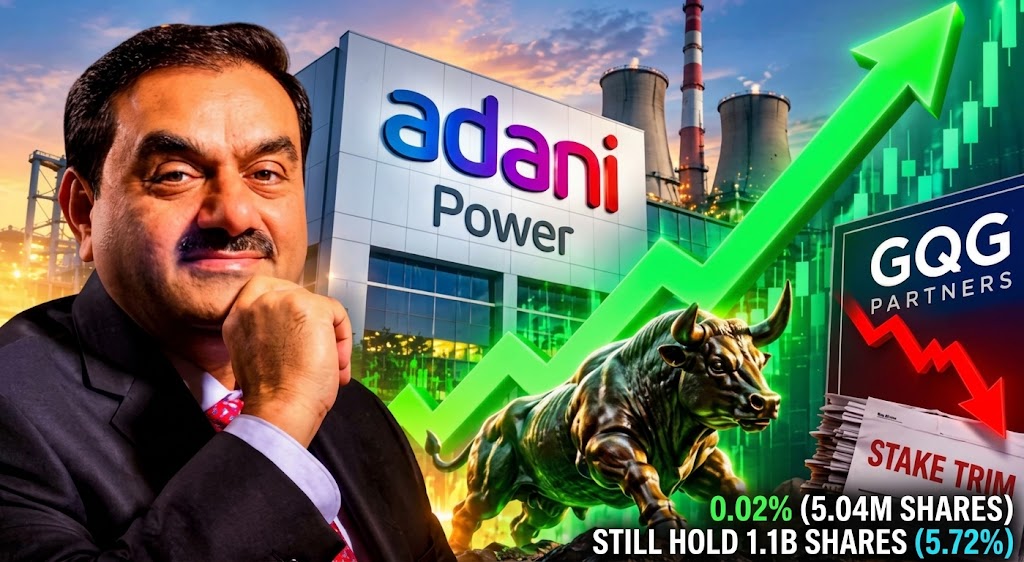
Hey everyone! 👋 If you’ve been keeping a close eye on Indian energy equities, you know that any move by big-ticket Institutional Investors (FPIs) in Adani group stocks usually sends shockwaves through the market.
So when news broke that GQG Partners—the US-based investment firm that famously backed Gautam Adani’s empire during its toughest phase—sold off millions of shares in Adani Power, you might have expected a sharp sell-off.
Surprisingly, the market reacted with a calm nod! Bulls outperformed bears, and the stock actually closed higher at ₹188.60 on the NSE.
Let’s unpack what GQG’s transaction really means, analyze Adani Power’s multi-year chart, and review expert price targets and risk management levels.
1. The Details Behind GQG Partners’ Stake Sale
According to official regulatory filings submitted to Indian stock exchanges, GQG Partners executed multiple open-market transactions to trim its position.
- Shares Sold: GQG unloaded 5,039,326 shares (0.02% of the company’s total equity).
- Holding Shift: This marginally reduced GQG’s net share count in Adani Power from 1,107,475,959 shares down to 1,102,436,633 shares.
- Percentage Impact: Their overall stake effectively dipped from 5.74% to 5.72%.
Blogger’s Take: Is this a red flag? Not at all. Trimming a 0.02% position out of a massive 5.7% stake is classic profit-booking and routine portfolio rebalancing. GQG still holds over 1.1 billion shares in Adani Power. If a major marquee backer sells a tiny fraction and the stock price stays green, it highlights underlying market absorption and retail/institutional demand.
2. Technical Analysis & Expert Stock Targets
Despite short-term volatility since mid-2026—which saw the stock slide from around ₹250 down to the ₹190 range—technical analysts view the long-term chart structure as bullish.
According to Mahesh M Ojha (VP of Research & Business Development at KC Securities):
- Monthly Trend: The long-term price action remains positive.
- Key Support Levels: Strong downside support is identified at ₹180 and ₹168.
- Immediate Resistance: The stock faces a minor barrier at ₹200.
- Upside Target: A decisive breakout above ₹200 opens up a short-term target of ₹225.
Actionable Trading Strategy:
- Existing Shareholders: Hold current positions, keeping a strict stop-loss set at ₹168.
- New Investors: Consider a “Buy on Dips” approach near support zones, targeting ₹225 with a protective stop-loss at ₹168.
3. The Big Picture: Multibagger Returns for Long-Term Holders
While short-term traders focus on the 5-month consolidation, long-term investors are sitting on massive gains:
- Year-to-Date (YTD) Return: Up ~26%.
- 5-Year Multibagger Performance: Over 825%+ returns, making it one of the most profitable power sector plays on the Indian exchanges over the past half-decade.
As India’s industrial power demand continues to hit record highs, power generation giants with strong thermal and renewable capacities remain crucial utility plays for long-term growth.
My Key Takeaways for Investors
- Don’t Panic Over Institutional Rebalancing: Institutional investors frequently trim small fractions of their holdings for liquidity, reallocations, or fund mandates. Focus on the total holding percentage rather than headlines.
- Respect Stop-Losses: Whether buying afresh or holding, keeping a strict stop-loss at ₹168 protects your capital if broader market sentiment pivots.
- Patience During Consolidation: Energy stocks often undergo extended consolidation phases after explosive multi-year runs. Accumulating near proven support zones usually yields better risk-reward ratios than buying during hype spikes.
Disclaimer: This article is strictly for educational and informational purposes. Views and price targets mentioned belong to independent market analysts. Always consult a certified financial advisor before making investment decisions.
Are you holding Adani Power shares in your portfolio? Are you buying this dip or waiting for a breakout above ₹200?